

{blogtober day 3} MOCStober :: creating everyday
Film was where I first fell in love with photography; as a child I was given a point & shoot and I was immediately enchanted with capturing the world around me. Of course, like a child, I didn’t understand the actual cost of film photography – I remember clearly my parents horror to learn I’d shot an entire roll on a single afternoon’s outing. At the time, I just wanted to record everything I was seeing. As an adult who has to pay her own film and developing costs, I am horrified right along with them. Over my teenage years I took photos on and off, and I considered photography as a HSC subject but ran out of units to fit it in after I’d filled my timetable with my prerequisites and science subjects of interest. Then came adulthood, and with it work and uni. The photos dropped off. For a time, anyway, until I met my husband and he taught me how to use his Pentax MZ-50 SLR.
I fell in love with photography all over again, now I knew how to do it “properly”, and could exert control over my images that wasn’t possible with the point and shoots I’d had until then. I devoured books. I regressed to my 12 year old self and took a million photos of all the things (like all good novice photographers, my body of work heavily skewed towards sunsets, random flowers, and our dogs). We hauled the Pentax to Thailand, where we shot eight rolls in the two weeks. Thankfully both film & developing were cheaper there!
For my birthday in 2005, my husband spent weeks building me up to the idea he was getting me an iPod that I’d been thinking of getting but couldn’t bring myself to splurge on. After a few layers of pass the parcel, I finally got to the goodies – a Nikon D50 twin lens kit. A gadget I’d been dreaming of but didn’t even dare try to convince myself I could justify. From there, the obsession began in earnest, and I was shooting constantly. My lens collection grew – a 50mm**, to start with, and from there they just got bigger and funner. Over the years the camera body evolved too. From the D50, I went up to a D90, then a D700, and most recently, a D850** which remains an absolute dream to use.
When I fell down the rabbit hole of Flickr somewhere around 2010 and first took on a 365, I was continually inspired by the amazing film photographers in the groups I was discovering.Polaroid was in it’s dying days (later rescued by the Impossible Project) but had a cult following. Lomography and plastic cameras with deliberate light leaks were all the rage. 35mm and medium format groups exposed me to new film stocks and ways of shooting. The call of the siren’s song was strong, and I found myself browsing eBay on the regular. From there it was just a small drop down a slippery slope, and suddenly I started collecting film cameras.
The first was a Polaroid 600, followed rapidly by a Nikon F55, a simple, entry level film camera (one of the last before Nikon went fully digital) that I could use my existing lenses on. From there it was a short hop skip & jump into lomography with a Holga 120N**, and my mum caught on and bought me a Blackbird Fly TLR. Then at camp, Car jumped on board and in my goodie bag was a Holga Mini 110 – pink and perfectly matching hers. Along the way, I also built out a collection of vintage cameras, starting with a brownie starlet that was all the rage in my groups, up to and including my grandfather’s Box Brownie that he took with him to Nashos training in the 50s.
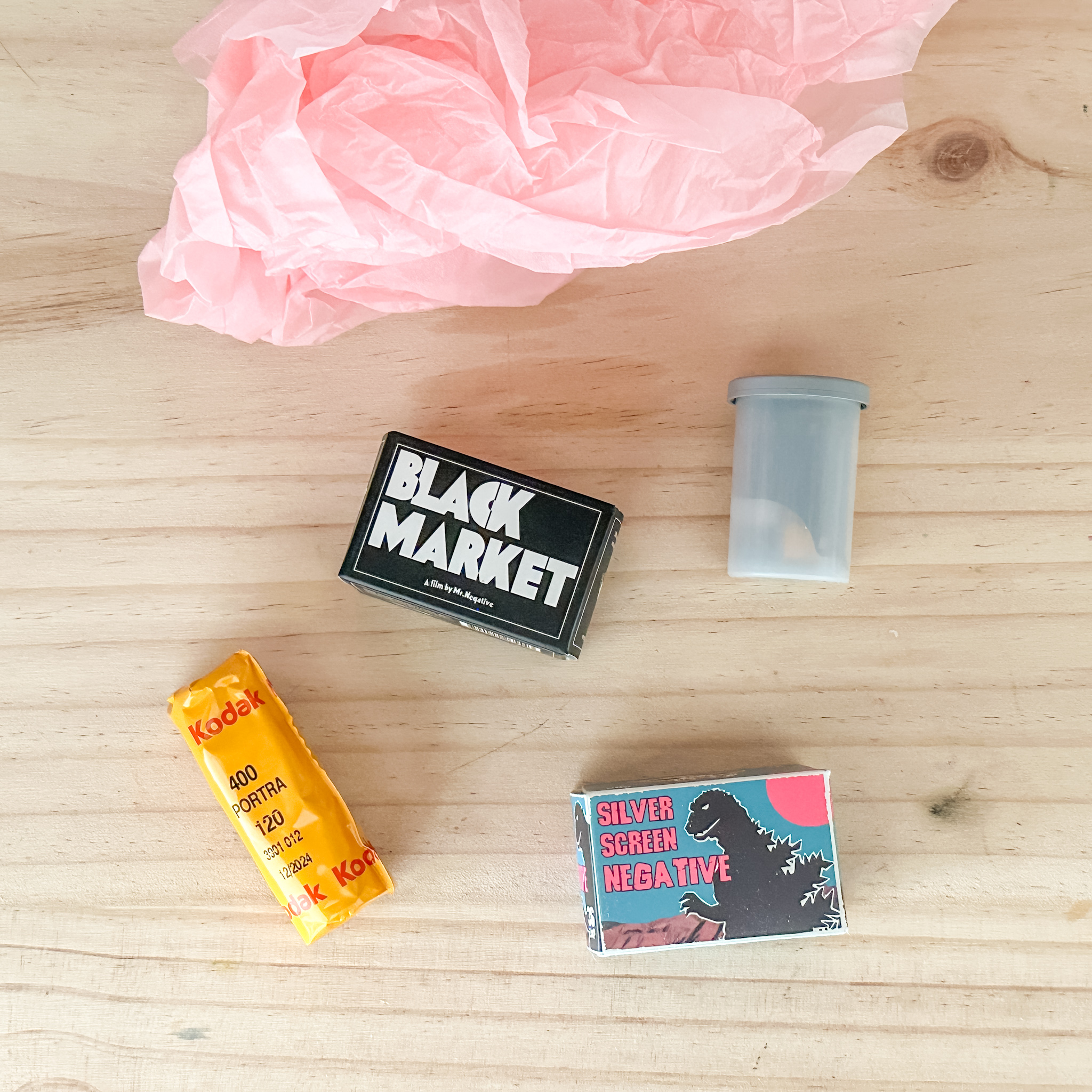
Tiny house life meant they had be to packed away, though, and this month, I’m excited to pull my collection out and reengage with the slow intentionality that comes with analogue photography. Every day of #MOCStober I’ll be pulling one of these beauties out and taking a photo old school style. A far cry from my “free roll of Kodak Gold with every roll developed at the chemist”, I spent a long time searching the internet for a developing lab (I’ve settled on FotoFast in Brisbane) and a source for film (Mr Negative in Melbourne) – my preferred colour film stock these days is Kodak Portra, so I grabbed a roll of 400 speed in both 35mm and 120, plus two of Mr Negatives specialty films, namely Black Market B&W, and Silver Screen Negative as a cinematic colour film. I’m super excited to try them all out – the Portra 120 will go in the Holga, and then I’m thinking Black Market in my Nikon. For the Blackbird Fly I’m tempted to try the Silver Screen, I think the colours of the film will pair well with the fun vibe of the Fly. Then I have some black & white 110 still coming for the mini.

I’ve written a lot in this space and on substack about the women who’ve come before me, who I find connection with through my exploration of the domestic arts. When it comes to photography though, it is really no surprise I fell into it in such a big way, with both my grandfathers being avid hobbyists. My paternal grandfather is the one who’s brownie I am now the proud guardian of, and my maternal grandfather, whom I never knew, having died when my mum was still a teen, was the creator of boxes and boxes of slides; slides which inspired an element of an art piece I made earlier in the year and shared the progress of with my paid substack subscribers.
Going back to film and a simpler way of shooting is a fun way to remember them as I work this month. If I feel brave, I might even try and load the 720 film I bought off eBay into the brownie and see what comes of it. It’s also a joy to see my biggest boy, who has long borrowed my cameras, and now has a Nikon zFC of his own, inspect my collection and tell me how he wants to learn film as well, to the point of developing it himself – something I’d once thought of doing, but chemicals and toddler are not exactly a great mix. His astrophotographry is especially good, and I’m looking forward to see the way he uses his camera to document his changing world next year as he packs up and leaves us.
Slow, intentional creating. Multigen connections. The perfect project to explore this month.

 A weekly podcast on creativity, connection, community and collaboration

